
The Employee PII Exposure Score: A 2026 Framework for HR and Security Leaders
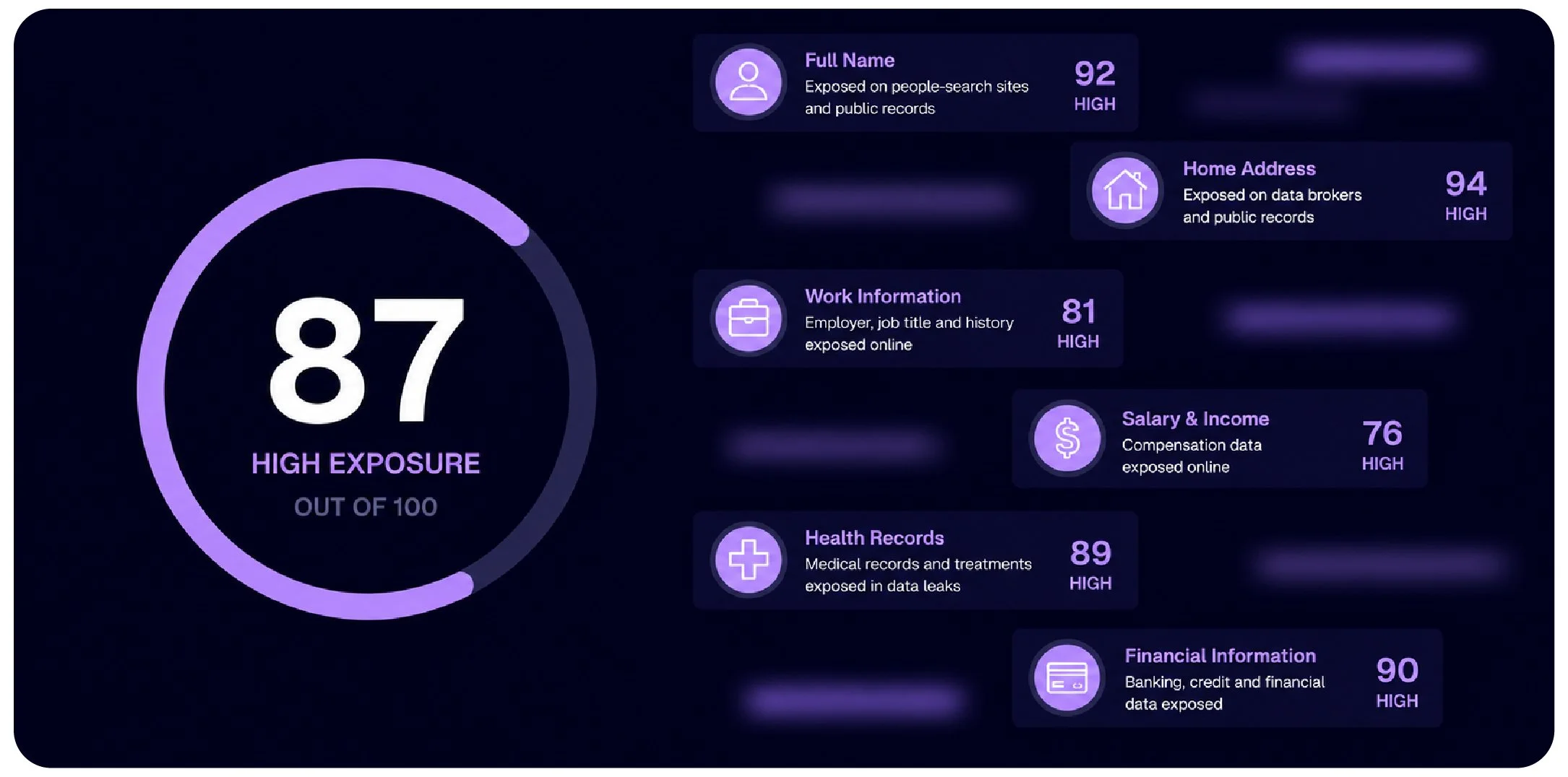
Every HR and security team has a vendor scoring framework, an endpoint posture score, and a phishing-simulation pass rate.
Almost none have a measurable, reportable score for how exposed their employees' personal data actually is across the open web, data brokers, breach corpuses, and people-search sites.
Verizon's 2026 Data Breach Investigations Report (DBIR) places credential abuse, phishing, and pretexting among the leading initial-access vectors. Employee PII fuels all three.
This framework introduces the Employee PII Exposure Score: a practical model HR and security teams can implement within 90 days, report on quarterly, and connect to executive protection, privacy benefits, and employee risk reduction.
TL;DR
Credential abuse, phishing, and pretexting remain dominant breach entry points.
NIST SP 800-122 provides a foundation through its PII confidentiality impact levels.
The Employee PII Exposure Score adapts those principles into a practical HR and security framework.
The model uses five exposure dimensions, three impact levels, and one organizational score.
The framework aligns with the NIST Privacy Framework.
The score can be paired with deletion programs, executive protection initiatives, and employee privacy benefits.
Why a Score Matters in 2026
Two forces are converging.
1. Identity-Based Attacks Continue to Grow
Credential abuse, phishing, and pretexting continue to account for a significant share of breaches.
Attackers build convincing campaigns using information gathered from:
Data brokers
People-search sites
Public records
Breach databases
Social media
The more information available about an employee, the easier it becomes to impersonate them or manipulate them.
2. Regulatory Pressure Is Increasing
Recent enforcement actions and new privacy regulations are placing more attention on personal data exposure.
Organizations now need a way to measure whether privacy initiatives are reducing employee risk.
Without a measurable score:
HR cannot demonstrate the value of privacy benefits.
Security teams cannot quantify employee exposure.
Leadership cannot track progress over time.
The Employee PII Exposure Score solves this gap.
The Framework
The Employee PII Exposure Score is a NIST-aligned framework built around:
Five exposure dimensions
Three impact tiers
One organizational score
Each employee receives an individual score.
Scores can then be aggregated by cohort:
Executives
IT and Security
Finance
Customer-facing teams
General workforce
The organization receives a single quarterly score for reporting.
The Five Exposure Dimensions
1. Identity Surface
Measures how much personally identifiable information can be discovered online.
Examples include:
Full name
Date of birth
Home address
Employer history
Family associations
SSN-linked records
The greater the volume and sensitivity of discoverable information, the higher the score.
2. Location Traceability
Measures whether a person's movements or locations can be inferred.
Examples include:
Home addresses
Frequent travel locations
School locations
Religious institutions
Medical facilities
Military facilities
Location exposure can create risks ranging from harassment to physical threats.
3. Credential Exposure
Measures exposure of credentials tied to corporate or personal accounts.
Examples include:
Leaked passwords
Breach appearances
Credential reuse
Credentials linked to SSO systems
This is often the most actionable area for security teams.
4. Pretextable Context
Measures information that enables convincing impersonation.
Examples include:
Job titles
Reporting structures
Manager relationships
Vendor relationships
Calendar patterns
Personal interests
This information helps attackers build believable social engineering campaigns.
5. Family and Household Exposure
Measures exposure involving household members.
Examples include:
Spouses or partners
Children
Shared addresses
Family-linked records
Attackers increasingly use household information as an indirect path to high-value employees.
The Three Impact Tiers
Each dimension receives one of three ratings.
Low (1 Point)
Information is limited or intentionally public.
Examples:
LinkedIn job title
Corporate email address
Potential harm is minimal.
Moderate (2 Points)
Information can be linked to an individual but does not immediately enable impersonation or location tracking.
Examples:
Outdated broker listings
Old credential leaks that have been remediated
Potential harm is meaningful but manageable.
High (3 Points)
Information enables direct abuse, impersonation, or targeting.
Examples:
Current home address
SSN-linked records
Active credential exposure
Family-linked identifiers
Potential harm is substantial.
Calculating the Score
Each employee can receive a maximum score of:
15 points
(5 dimensions × 3 points)
Organizational Rollup
Calculate individual employee scores.
Average scores within each cohort.
Weight executive and IT administrator cohorts more heavily.
Convert the result to a 0–100 scale.
Interpretation
ScoreMeaning0–20Mature privacy program21–50Moderate exposure51–70Elevated exposure70+Unmanaged exposure
Lower scores are better.
Mapping to the NIST Privacy Framework
Identify-P
Supports inventorying employee data exposure.
Relevant dimensions:
Identity Surface
Location Traceability
Family and Household Exposure
Govern-P
Establishes ownership between:
HR
Security
Legal
Relevant dimension:
Pretextable Context
Control-P
Focuses on reducing exposed information.
Relevant dimensions:
Identity Surface
Location Traceability
Communicate-P
Provides a measurable score for reporting.
The Employee PII Exposure Score itself becomes the reporting mechanism.
Protect-P
Focuses on credential security.
Relevant dimension:
Credential Exposure
A 90-Day Rollout Plan
Days 0–30: Inventory and Baseline
Define employee cohorts.
Measure data broker exposure.
Measure credential exposure.
Document all findings across the five dimensions.
Days 30–60: Score the Organization
Calculate employee scores.
Build cohort reports.
Create leadership dashboards.
Present baseline findings.
Days 60–90: Reduce Exposure
Prioritize executive exposure.
Remove broker listings.
Submit applicable deletion requests.
Strengthen SSO and MFA adoption.
Re-score employees after remediation.
The result is a measurable before-and-after comparison.
How This Fits With Existing Programs
Executive Protection
Executive cohorts naturally align with executive protection initiatives.
The score identifies which leaders face the greatest exposure.
Privacy as an Employee Benefit
Organizations can use the score to measure whether privacy benefits reduce risk.
This turns privacy from a perk into a measurable security control.
Household Protection
The family and household dimension extends protection beyond the employee.
This helps reduce indirect targeting risks.
What to Tell the Board
A simple board-level summary could look like this:
"Our Employee PII Exposure Score currently sits at X, with executives at Y. We are targeting a 30-point reduction over the next 12 months through broker deletion, credential protection, and employee privacy initiatives."
The message is simple:
Lower is better.
Progress is measurable.
Results can be reported quarterly.
Where Priwall by mePrism Fits
Priwall by mePrism helps organizations:
Discover exposed employee data
Execute data broker removals
Submit deletion requests
Track exposure reduction
Measure progress over time
The result is a measurable Employee PII Exposure Score that leadership can monitor and report on.
Ready to try Priwall by mePrism yourself?
If you are an individual executive evaluating personal coverage outside an employer-funded program, you can start with a free exposure scan.
Sign up for Priwall by mePrism coverage.Frequently Asked Questions
Is the Employee PII Exposure Score a NIST standard?
No.
The framework is based on NIST SP 800-122 and the NIST Privacy Framework but is not an official NIST standard.
How is this different from dark web monitoring?
Dark web monitoring focuses primarily on credential exposure.
The Employee PII Exposure Score also measures:
Identity exposure
Location exposure
Pretextable information
Household exposure
Who owns the score: HR or Security?
Both.
HR and Security share responsibility for maintaining and reducing employee exposure.
How often should organizations re-score?
At minimum:
Quarterly for organization-wide reporting
Monthly for executive protection programs
Additional scoring should occur after major public events or leadership changes.
Does this replace a CCPA or CPRA program?
No.
The score measures outcomes.
Privacy compliance programs provide many of the actions used to reduce exposure.
By Thomas Daly, CEO, mePrism Privacy. Thomas leads mePrism Inc., the company behind Priwall by mePrism, and writes regularly on consumer privacy regulation and the B2B economics of data-broker removal.